

The 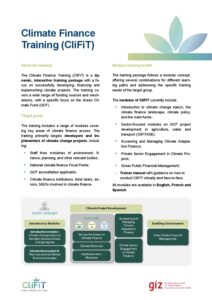 two introduction modules of CliFiT focus on 1) the basics of climate change and the international climate policy regime, as well as 2) the climate finance landscape and the main international climate funds.
They are specifically targeted at participants with little or no prior knowledge or can be integrated in whole or in part into the other modules.
Th e main objective of this module is to help climate project developers to better understand the adaptation finance landscape, different options in financing adaptation projects, potential challenges, and how to meet them.
In particular, the module helps participants to:
The training is divided into eight sub-modules covering both theoretical and practical aspects around the topic.
The main objective of this module is to help climate project developers better understand the private sector, its needs and interests, the value of engaging it in climate projects, and different ways to go about it.
In particular, the module helps participants to:
The training is divided into five sub-modules covering both theoretical and practical aspects around the topic and including a range of exercises and case studies.
CliFiT4SE was designed to meet the training needs of  sector experts on developing climate projects, specifically for the Green Climate
Fund (GCF). The training toolkit provides hands-on information and instruments to develop a theory of change and climate rationale and conceptualise concrete climate project ideas.
The primary target group for CliFiT4SE are sector experts who have an interest in exploring climate finance options. The training currently covers three sectors (water, agriculture and transport) but can be adapted to other sectoral contexts as well.
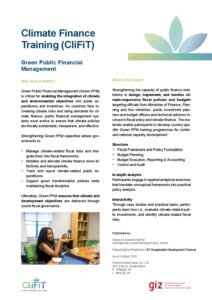
Targeting Ministries of Finance, Planning and line ministries at national or sub-national level, this training was developed in collaboration with the Sustainable Development Finance Sector Programme. It focuses on strengthening the capacity of public finance institutions to design, implement, and monitor climate-responsive fiscal policies and budgets across the entire public financial management cycle.
The main objective is to enhance partner countries’ capacity to design and implement Green PFM reforms, while enabling participants to develop country-specific Green PFM training programmes for continued national capacity development. Including case studies and analytical exercises that translate conceptual frameworks into practical policy analysis, the training is organized around four core sub-modules covering the full PFM cycle:
You are currently viewing a placeholder content from Vimeo. To access the actual content, click the button below. Please note that doing so will share data with third-party providers.
More InformationYou are currently viewing a placeholder content from YouTube. To access the actual content, click the button below. Please note that doing so will share data with third-party providers.
More InformationYou need to load content from reCAPTCHA to submit the form. Please note that doing so will share data with third-party providers.
More InformationYou need to load content from reCAPTCHA to submit the form. Please note that doing so will share data with third-party providers.
More InformationYou are currently viewing a placeholder content from Google Maps. To access the actual content, click the button below. Please note that doing so will share data with third-party providers.
More Information