As the world’s largest multilateral climate fund, the Green Climate Fund (GCF) forms a crucial part of the global climate finance architecture. It has a legally binding mandate to ensure that Small Island Developing States (SIDS) are eligible for access and to prioritise SIDS as it seeks to ensure efficient access and enhanced readiness support.
Evidence shows, however, that access for SIDS to GCF funding has been slow and that this group of vulnerable countries has not been prioritised. Three years after an independent evaluation highlighted serious shortcomings, it is more important than ever to highlight the reasons why the GCF is not adequately serving SIDS and make recommendations to help rectify this.
This policy brief draws on findings from a study conducted by the Resilient and Sustainable Islands Initiative (RESI) in 14 SIDS across three regions: the Caribbean; the Pacific; and the Atlantic, Indian Ocean and South China Sea. The brief sets out four recommendations for consideration by the GCF Board that would benefit SIDS and other vulnerable countries:
- revisit the Simplified Approval Process
- create a minimum country funding allocation
- increase its regional presence
- implement new operational modalities for readiness
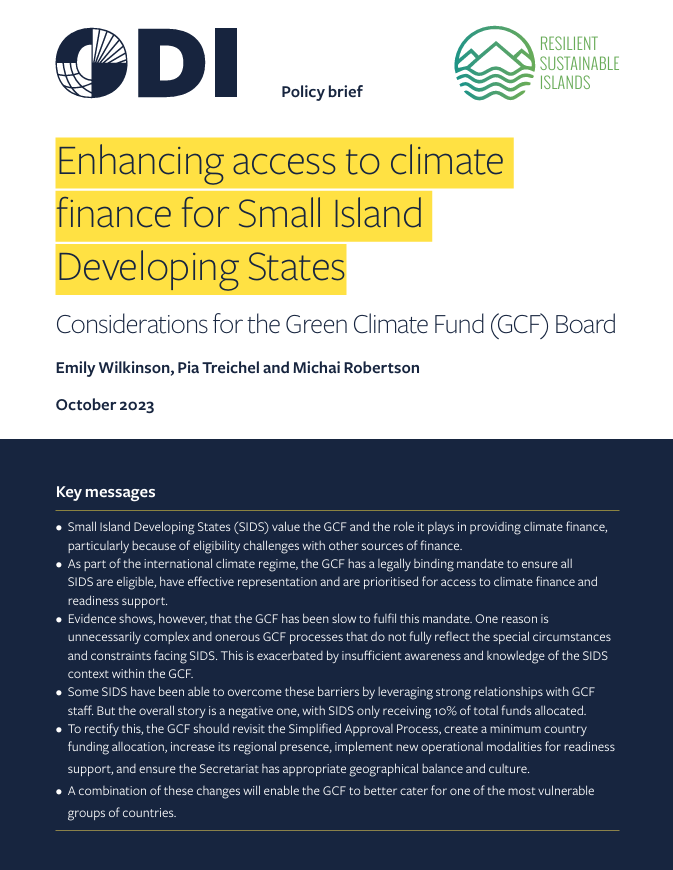
Authors: Emily Wilkinson, Pia Treichel and Michai Robertson
Key Messages
- Small Island Developing States (SIDS) value the GCF and the role it plays in providing climate finance, particularly because of eligibility challenges with other sources of finance.As part of the international climate regime, the GCF has a legally binding mandate to ensure all SIDS are eligible, have effective representation and are prioritised for access to climate finance and readiness support.
- Evidence shows, however, that the GCF has been slow to fulfil this mandate. One reason is unnecessarily complex and onerous GCF processes that do not fully reflect the special circumstances and constraints facing SIDS. This is exacerbated by insufficient awareness and knowledge of the SIDS context within the GCF.
- Some SIDS have been able to overcome these barriers by leveraging strong relationships with GCF staff. But the overall story is a negative one, with SIDS only receiving 10% of total funds allocated.
- To rectify this, the GCF should revisit the Simplified Approval Process, create a minimum country funding allocation, increase its regional presence, implement new operational modalities for readiness support, and ensure the Secretariat has appropriate geographical balance and culture.
- A combination of these changes will enable the GCF to better cater for one of the most vulnerable groups of countries.