Search
What are you looking for?

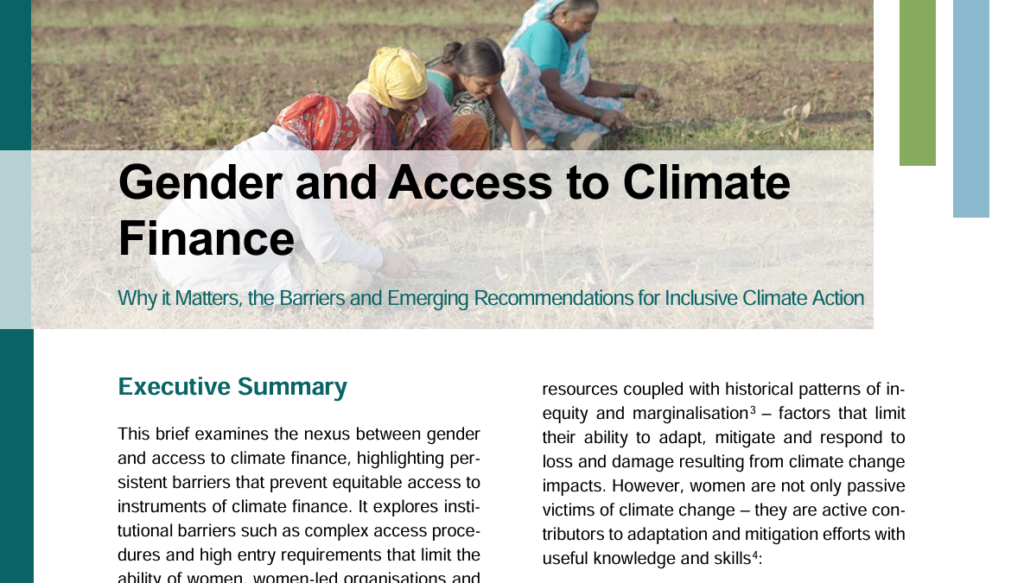
Policy Brief: Gender and Access to Climate Finance​

The brief examines the nexus between gender and access to climate finance recognizing that women and other marginalized groups are disproportionately impacted by climate change, yet they continue to face significant barriers in accessing instruments of climate finance.​

RECENT PUBLICATIONS

Peer-to-Peer Learning Alliance (P2P LA) on Climate Finance Integrity: Enhancing Integrity for Impactful Climate Action

Initiated in 2017, the Learning Alliance consists of eight Direct Access Entities (DAEs) from seven countries (Honduras, Morocco, Namibia, Nepal, Peru, Uganda, Vietnam). All members are accredited to the GCF and must and are tasked to uphold the respective integrity policies and standards. The P2P LA provides peers with a platform to strengthen dialogue and knowledge exchange on how to safeguard climate finance resources from abuse and misuse. In facilitating the Alliance, PfR works closely with the GCF’s Independent Integrity Unit and Transparency International. A series of knowledge products have been produced to harness the members’ knowledge and experiences and share them with a wider audience. Studies on various topics are therefore available, namely “Enhancing Integrity for Impactful Climate Action”, “Achieving Comprehensive Whistleblower Protection for Integrity in Climate Action”, “Promoting Integrity in Procurement for Meaningful Climate Action”, “Deterring, Managing and Mitigating Conflicts of Interest for Integrity in Climate Action” and “Ensuring Financial Integrity and Due Diligence in Funding for Climate Action”.​

Study “Supporting Climate-Compatible Financial Systems Development“​

The financial sector has a crucial role to play in the global transition to a low-carbon economy. This study assesses the current state of climate-compatible financial system development and provides recommendations on how climate-compatible financial system development could be scaled up, including with the cooperation of the international development community, particularly the Green Climate Fund (GCF). The study includes four case studies from four countries: South Africa, Mexico, Thailand, and Uganda. The study is targeted at relevant institutions in GIZ partner countries (e.g., ministries, banks, and investors), development cooperation institutions, donors, funds, and international networks, partnerships, and initiatives around climate finance.​

Brief: Peer-to-Peer Learning and Communities of Practice – Lessons Learned from Implementation

Peer learning and Communities of Practice (CoPs) are key tools to build capacities and ease access to climate finance by improving knowledge sharing and learning. From the range of peer learning formats that PfR has set up, implemented and supported, this brief summarizes the experiences and lessons learned that the project has gathered over time. It is meant to be a helpful resource for colleagues planning to set up similar programs.​

Language